Semrush Releases Expanded 2026 AI Visibility Index, Analyzing 126 Million AI Search Prompts
Semrush Releases Expanded 2026 AI Visibility Index, Analyzing 126 Million AI Search Prompts
The flagship study, scaled from an initial 2,500 prompts to 126 million U.S. AI search prompts, reveals how brands are mentioned, cited, and represented across AI-powered discovery environments — and why marketers need integrated SEO, content, and brand strategies to compete.
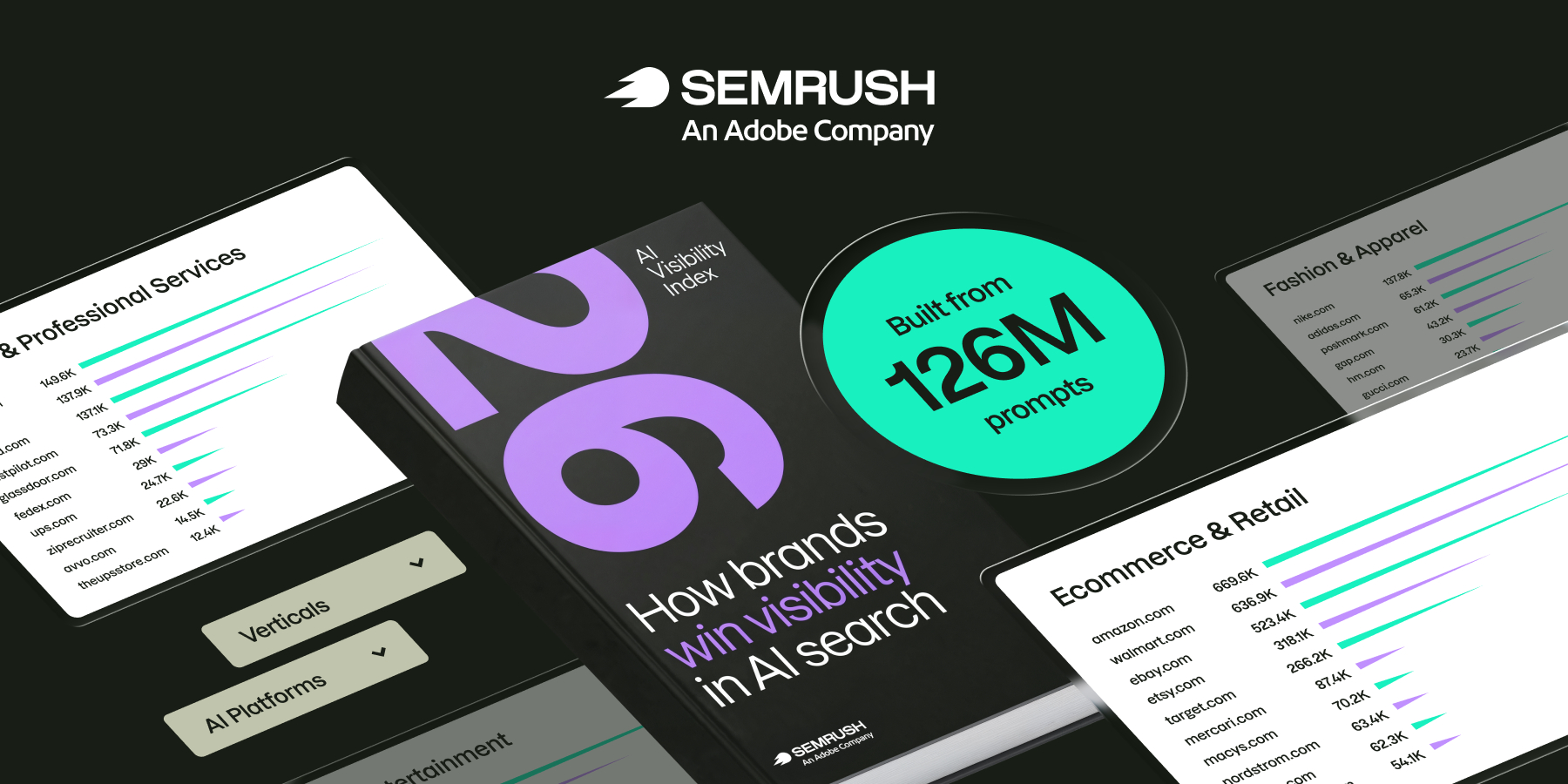
BOSTON--(BUSINESS WIRE)--Semrush, an Adobe company and the leading brand visibility platform, today announced the release of the 2026 AI Visibility Index flagship study. Building on the original AI Visibility Index, launched in September 2025, the report represents a major expansion of Semrush’s AI search intelligence capabilities, scaling from an initial analysis of 2,500 prompts to 126 million U.S. AI search prompts analyzed from January through April 2026. The expanded dataset offers one of the most comprehensive views to date of how brands are mentioned, cited, and surfaced across major AI search platforms — and how AI-powered discovery is reshaping brand visibility across industries.
The launch comes as consumers increasingly embrace AI-powered chat services and browsers to discover and evaluate product offerings. New data from Adobe highlights the substantial growth in this channel, where AI traffic to U.S. retail sites have surged 1,324% between October 2024 and May 2026. In the travel sector, AI traffic is up 2,215% in the same period. However, marketers face a growing measurement challenge. Semrush found that 45% of marketing leaders cannot accurately measure their brand visibility within AI-generated answers, while only 9% have the tools to track all relevant metrics across platforms.
The Index establishes benchmarks across 22 industries, helping organizations understand why brand performance can vary significantly between AI platforms and where new visibility opportunities are emerging.
“Your AI narrative is becoming the decisive entry point to your customer experience,” said Rachel Thornton, CMO, Adobe Enterprise. “But the new reality is, your customers are both people and AI agents. Minimizing brand drift to ensure accuracy and consistency across every digital touchpoint is now the starting point for securing visibility. This requires new content strategies, stronger data foundations, and organization-wide governance.”
AI Visibility Is Becoming a Brand Narrative Challenge
The Index shows that AI-powered discovery is no longer shaped by a single search result, owned website, or ranking position. Across ChatGPT, Gemini, Google AI Mode, and Google AI Overviews, brands are being interpreted, summarized, mentioned, and cited through different combinations of owned content, third-party sources, community discussions, publishers, retailers, and reference platforms – meaning brands must now compete not only to be found, but to be accurately understood and credibly supported.
The four platforms analyzed also demonstrate significantly different citation patterns. ChatGPT cites an average of 15 sources per response and frequently relies on community and reference platforms such as Reddit and Wikipedia, while Gemini cites an average of 3 sources per response, drawing on a smaller pool of citations that includes Wikipedia, Reddit, and YouTube. These differences help explain why a brand can perform strongly in one AI environment while having limited visibility in another, reinforcing the need to measure AI visibility platform by platform while strengthening the broader brand signals AI systems use to recognize, trust, and recommend brands.
“AI is now intrinsic to the default search experience, and brands need to adapt. The name of the game is Brand Visibility,” said Andrew Warden, Vice President of Marketing at Adobe and former CMO of Semrush. “The foundations of SEO are critically important in creating trust signals for AI, but visibility now depends on how consistently a brand reinforces its narrative across digital channels. Marketing teams need to redesign how they work across SEO, content, communications, data, and brand governance to compete in this new environment.”
Additional AI Visibility Index Takeaways
Beyond the headline findings, the study reveals several important dynamics shaping how brands appear, compete, and build trust across AI-powered discovery environments:
- Brand mentions and citations measure different forms of visibility. Being mentioned in an AI-generated answer does not necessarily mean a brand’s own website is cited as the supporting source. Mentions show how often a company appears in an answer, while citations show which domains and pages AI platforms use as evidence. On Gemini, the overlap between mentioned brands and cited domains can be as low as 30%, reinforcing the need for brands to compete on two fronts: earning enough authority and relevance to be mentioned, while also creating credible, structured content that AI platforms can cite.
- Competitive opportunity varies significantly by industry. The Index found major differences in how concentrated AI visibility is across categories. In News and Media, the three most visible brands accounted for 82.9% of total category visibility, while in Consumer Electronics, the top three represented 76.9%. By comparison, visibility was more distributed in Finance, where the top three brands accounted for 41.4%, and Industrial, where they represented 42.2%. These less concentrated categories may offer greater opportunities for brands to gain visibility over time.
- Only 36 brands maintained visibility across every platform. Despite major differences between AI environments, only 36 global brands maintained top-100 visibility across all four platforms during every month of the study. The “Universal 36” include YouTube, Google, Reddit, Amazon, Facebook, Apple, Walmart, Disney, and Nintendo. These brands tend to share several advantages: broad consumer reach, sustained recognition, and a clear role in helping users complete discovery, comparison, or transaction-related tasks.
- Third-party sources now play a critical role in shaping brand narratives. The study finds that a company’s AI narrative is no longer shaped solely by owned websites and brand-controlled content. AI platforms also rely on customer reviews, community discussions, independent publishers, retailers, and industry sources to understand and recommend brands. Patagonia, for example, maintained an AI visibility score of approximately 79–80 throughout the study period, supported by consistent descriptions across sources including OutdoorGearLab, REI, Switchback Travel, GearJunkie, and Reddit.
- Integrated SEO and AI strategies deliver stronger results. The companion survey identified a clear performance gap between integrated and siloed search strategies. Among organizations that fully integrate SEO and AI visibility into a unified workflow, 81% reported increased traffic or leads from AI platforms. Among organizations managing the two areas separately, only 36% reported the same result. The finding suggests that AI visibility is most effective when connected to existing SEO, content, communications, and brand programs rather than treated as a standalone initiative.
Availability
The 2026 AI Visibility Index is available now at https://ai-visibility-index.semrush.com/ and https://business.adobe.com/solutions/brand-visibility.html?ai-visibility. The report includes platform and industry benchmarks, brand case studies, and guidance for organizations building integrated AI visibility strategies.
About Semrush
Semrush, an Adobe company, is the leading brand visibility platform, empowering marketers to command their online presence and create measurable impact. Built on the industry’s most expansive proprietary dataset, Semrush delivers AI-driven insights across SEO, Agentic Search Optimization, content marketing, paid media, and social strategy. Used by over 28 million users globally – from scaling startups to the Fortune 500 – Semrush provides the competitive intelligence needed to win visibility in an evolving digital landscape.
Contacts
Public Relations
pr@semrush.com