
Legislature and CalCIMA Celebrate 50 Years of Surface Mining and Reclamation Act (SMARA) in California
Legislature and CalCIMA Celebrate 50 Years of Surface Mining and Reclamation Act (SMARA) in California
Landmark law marks half a century of responsible resource development and land reclamation across California.
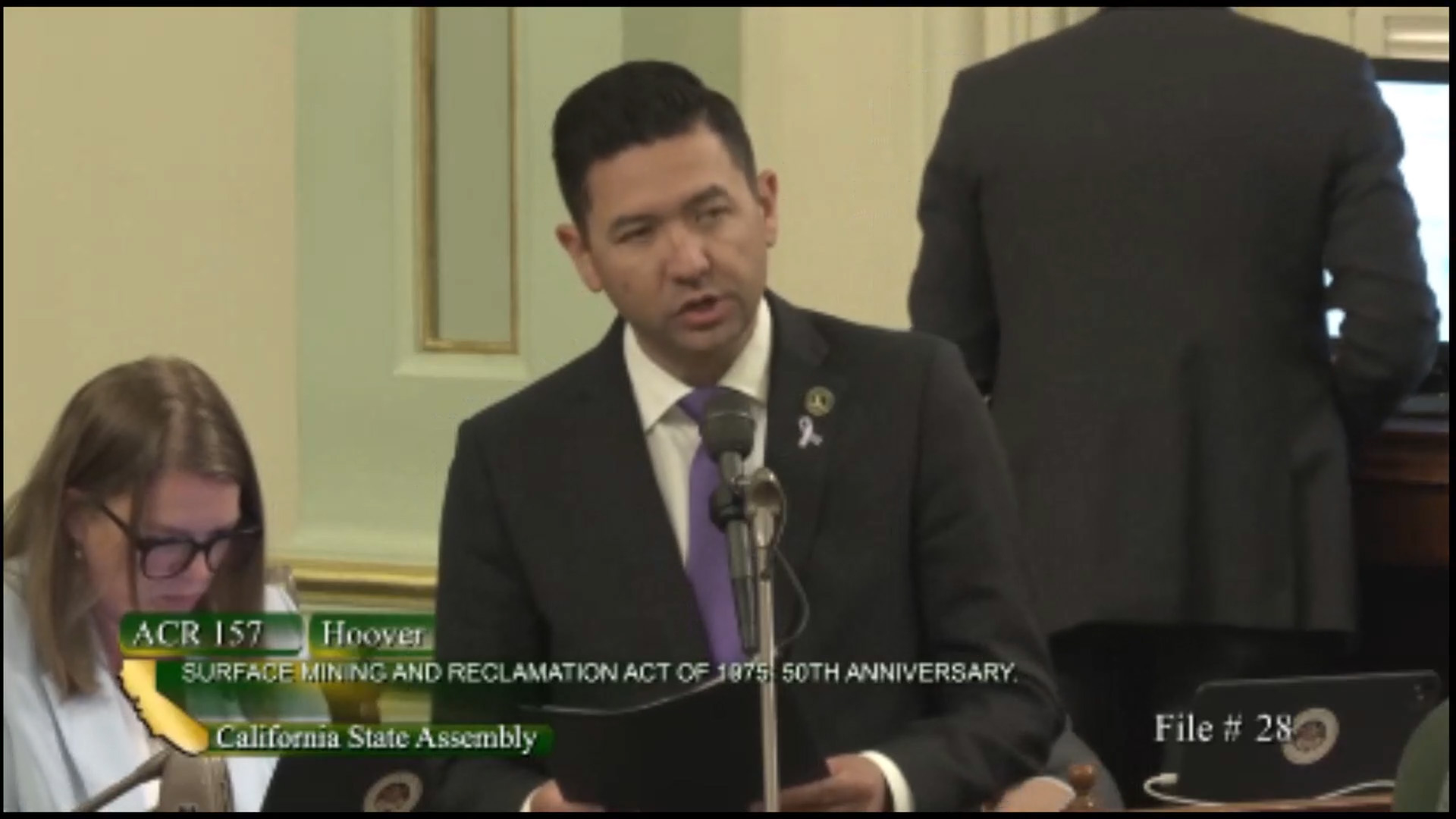
Authored by Assemblymember Josh Hoover (R-Folsom) with bipartisan support and co-authorship from Assemblymembers Jasmeet Bains (D-Delano), Stephanie Nguyen (D-Elk Grove) and more than 50 other members, the resolution celebrates five decades of environmental stewardship, community partnership, and sustainable resource management.
SACRAMENTO, Calif.--(BUSINESS WIRE)--The California State Assembly Monday approved ACR 157, commemorating the 50th anniversary of the Surface Mining and Reclamation Act (SMARA), the landmark for responsible mineral resource development and land reclamation. Authored by Assemblymember Josh Hoover (R-Folsom) with bipartisan support and co-authorship from Assemblymembers Jasmeet Bains (D-Delano), Stephanie Nguyen (D-Elk Grove) and more than 50 other members, the resolution celebrates five decades of environmental stewardship, community partnership, and sustainable resource management.
"SMARA is a California success story that doesn't get nearly enough credit. For fifty years, this law has proven that environmental protection and responsible resource development work hand-in-hand rather than operating as opposing forces."
Share
"SMARA is a California success story that doesn't get nearly enough credit," said Assemblymember Hoover. "For fifty years, this law has proven that environmental protection and responsible resource development work hand-in-hand rather than operating as opposing forces. The materials that build our homes, schools, roads, and clean energy infrastructure must come from somewhere, and SMARA ensures they come from somewhere responsibly. I'm proud to author this resolution honoring that legacy."
Signed into law by Governor Jerry Brown and authored by Senator John Nejedly, SMARA took effect January 1, 1976, and created a model of shared responsibility between local governments, state agencies, and industry to fill a critical gap left by patchwork regulation.
"Aggregate is essential to the needs of modern society, providing material for the construction and maintenance of roadways, dams, canals, buildings and other parts of California's infrastructure," according to the California Geological Survey, Department of Conservation for the State of California.
"Fifty years after SMARA's enactment, that observation from state officials remains as true today as it was when California first established this framework for responsible mineral resource development and reclamation," said Robert Dugan, President and CEO of the California Construction and Industrial Materials Association (CalCIMA). "Former mining sites have become parks, wildlife habitat, neighborhoods, water facilities, and community assets across this state. Many Californians enjoy those places today without ever knowing their history. That's the legacy of SMARA, and it's one CalCIMA and our members are proud to have been part of."
SMARA is administered through a partnership between the Department of Conservation, the State Mining and Geology Board, local governments, and mineral producers; it has facilitated the reclamation of mining lands into open space, wildlife habitat, parks, agricultural lands, housing, commercial developments, and water infrastructure throughout California.
SMARA emerged from California's environmental awakening of the late 1960s and early 1970s, a period that produced landmark legislation, including the California Environmental Quality Act (CEQA) and federal Clean Air and Clear Water acts. Over five decades, SMARA has been updated and strengthened while remaining true to its original conservation philosophy; that responsible extraction and long-term land restoration can be complementary. Reclaimed mine sites across California now serve as housing developments, parks, wetlands, agricultural lands, and water facilities, a testament to a framework that has quietly shaped California's working landscapes for half a century.
ACR 157 this week recognized not only the law's environmental achievements but its role in securing the material supply chains that underpin California's housing affordability goals, transportation investments, climate adaptation efforts, and domestic critical mineral supply chains.
CalCIMA is recognizing SMARA’s real-world impact through its first-ever Golden Anniversary Reclamation Awards. The submissions showcase the diversity of outcomes that responsible reclamation makes possible, including:
- Granite Construction – Vineyard (Sacramento County): Restoring habitat and open space while preserving the character of a California stream and working landscape.
- Teichert Materials – Aspen IV (Sacramento County): Demonstrating how active mining and reclamation can work together to create lasting community value.
- Yolo County – Muller 90 (Yolo County): Transforming mined lands into a thriving habitat and open space resource for future generations.
- BoDean, a CRH Company – Mark West Quarry (Santa Rosa, Sonoma County): Advancing concurrent reclamation through the integration of mining, stewardship, and long-term land management.
- Graniterock – Wilder Sand Plant (Santa Cruz, Santa Cruz County): Restoring native habitat and wetland ecosystems for California red-legged frogs and other sensitive species.
- Cache Creek Conservancy – Cache Creek Nature Preserve / Woodland Plant (Yolo County): Reconnecting people, wildlife, and working landscapes through innovative reclamation.
- 711 Materials – Sawyer Pit (Stanislaus County): Returning mined lands to productive agricultural use while supporting long-term community needs.
- Stonebridge Properties – Coldstream Road (Truckee, Nevada County): Transforming a former mine site into a vibrant mountain community.
- George Reed, Inc. – Reed-Clements Mine (Stanislaus County): Demonstrating how reclamation can be integrated into ongoing operations to create lasting value.
- CalPortland Company – Colton Quarry (Colton, San Bernardino County): Reclaiming a historic cement plant and quarry to create new opportunities for community and economic development.
- Granite Construction – Gardner Facility (Santa Barbara County): Showcasing how phased reclamation can support resource production, disaster recovery, and agricultural stewardship.
- Vulcan Materials Company – Vulcan Reliance II (Irwindale, Los Angeles County): Backfilling and reclaiming a former aggregate mine through large-scale engineered fill.
- Vulcan Materials Company – Mission Valley (San Diego, San Diego County): Transforming former mining lands into a transit-oriented community through river restoration, flood management, and reclamation.
- Sespe Consulting / Riverpark LLC – Riverpark (Oxnard, Ventura County): Transforming former aggregate mining pits into a master-planned community while preserving groundwater recharge and water management functions.
Details can be found at: https://calcima.org/page/SMARA_50
About CalCIMA: The California Construction and Industrial Materials Association (CalCIMA) represents producers of construction aggregates, asphalt, concrete, cement, industrial minerals, and critical minerals, including rare earths. CalCIMA members provide the foundational materials for California's roads, bridges, schools, hospitals, water systems, housing, and clean energy infrastructure.
Contacts
Stephanie Pridmore, CalCIMA
(916) 554-1000 | spridmore@calcima.org